A door handle is a small detail you touch every day. The right Lever Handles should feel natural in the hand, suit the door, and stand up to repeated use. AARP’s 2021 Home and Community Preferences Survey found that 77% of adults aged 50 and older wanted to remain in their homes as they aged. That makes everyday usability worth considering, even in a simple hardware choice. But a survey cannot tell you which handle will feel comfortable in your home.
Architect and universal-design advocate Ronald Mace described universal design as “the design of products and environments to be usable by all people, to the greatest extent possible.” His principle offers a useful lens for choosing Lever Handles: consider grip, reach, finish, door weight, and who will use the space. A smooth return lever may be easier to operate than a round knob, while a polished finish can show fingerprints beside a busy entry. Small differences matter.
There is no perfect handle for every door. I would also avoid choosing by appearance alone; that is an easy mistake to make. These ten tips explore practical checks, from measuring the backset and confirming compatibility to comparing materials, maintenance, and accessibility. Use them as a starting point, then test the handle in person if possible. A few seconds of real handling can reveal what a product photo cannot.
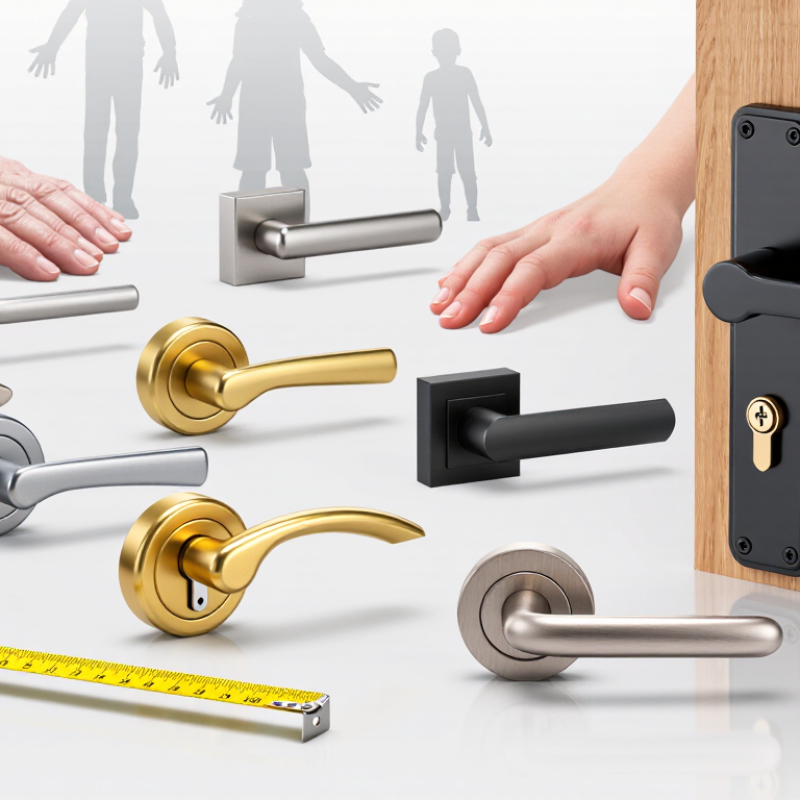
Lever handles are easier to choose when you start with the door’s job. Passage handles have no lock, so they suit hallways, closets, and rooms where privacy is not needed. A privacy lever usually has a push button or small turn lock. It works for bedrooms and bathrooms, but check that it has an emergency release for accidental lock-ins.
Keyed entry levers secure exterior doors and some rooms that need controlled access. Match the lock to the door’s thickness and existing holes; measuring twice can prevent an annoying return trip. Dummy levers do not turn a latch. They are fixed pulls for closet doors or paired doors that open with a separate latch. They can look right and still be the wrong choice if the door needs to latch.
Shape matters, too. A straight lever may catch on a bag or sleeve in a narrow passage, while a curved end can reduce that snagging risk. Lever handles are often easier to operate than knobs when someone has limited grip strength, but the mounting height and turning resistance still matter. Try the motion before buying, if possible. Feel the return. Check whether the lever springs back cleanly and whether its finish feels slippery with damp hands. I have found that a handle that looks comfortable in a photo can feel awkward at the wrist; that detail is easy to overlook.
Before choosing a lever handle, check the door itself. Measure its thickness, the distance from the edge to the handle bore, and the bore diameter. Confirm whether the door is left- or right-handed, and whether the latch and strike plate align. A few millimetres can matter. Existing holes may not suit a replacement handle, so compare them with the installation template before buying.
Tip: Check access and operation, too. The U.S. Access Board’s 2010 ADA Standards specify operable parts between 34 and 48 inches above the floor, with operating force no greater than 5 pounds. These figures are useful reference points for accessible installations; local requirements may differ. Check that the lever moves smoothly and does not require tight gripping or wrist twisting. A tape measure helps, but it cannot reveal a binding latch. Test the door in person where possible.
Before installation, confirm the handle’s stated door-thickness range and required tools. Inspect the latch faceplate, screws, and strike alignment; a loose fit can make a new handle feel faulty. Follow the supplied template, and avoid forcing screws into misaligned holes. If the door is fire-rated or part of an accessible route, check its documentation and applicable requirements before changing hardware. One detail is easy to miss: a lever can fit the door but still collide with nearby trim or a wall.
Lever handles face repeated contact, skin oils, cleaning chemicals, and occasional hard knocks. Material choice affects how they feel and age. Stainless steel generally suits damp or busy areas; solid brass offers substantial weight, while zinc-alloy options can reduce cost. Construction matters as much as the label. A hollow handle may feel less reassuring, though weight alone does not prove quality.
Tip: Match finish to the room. A matte finish can hide fingerprints, while polished surfaces show them quickly. Check the maker’s care instructions before using abrasive cleaners. Small detail. Big difference.
For durability, check test ratings rather than relying on appearance. ANSI/BHMA A156.2 grades locksets by performance; published cycle benchmarks are 1 million cycles for Grade 1, 400,000 for Grade 2, and 200,000 for Grade 3. These figures apply to tested locksets, not every standalone handle. ANSI/BHMA A156.18 covers architectural hardware materials and finishes, making it a useful reference when comparing finish specifications. Still, a test rating cannot predict every home’s conditions. Coastal air, frequent sanitizing, and loose installation can change how hardware wears. Check that screws stay tight, and inspect the finish where fingers touch most. Sometimes the practical choice is not the shiniest one.
| Tip | What to Compare | Typical Characteristics | Long-Term Consideration | Best Suited For |
|---|---|---|---|---|
| 1. Match the material to the environment | Solid brass, stainless steel, zinc alloy, or aluminum | Brass is substantial and corrosion-resistant; stainless steel is strong; zinc alloy is commonly used for cost-conscious interior hardware; aluminum is lightweight. | Moisture, cleaning products, and frequent use can affect materials and their coatings differently. | Choose materials according to the room, exposure, and expected use. |
| 2. Check stainless-steel grade | Grade and stated corrosion resistance | Grade 304 stainless steel is widely used indoors; grade 316 offers improved resistance to chlorides and is often considered for coastal or demanding environments. | “Stainless” does not mean stain-proof. Salt, harsh chemicals, and neglected cleaning can still cause surface discoloration or corrosion. | Bathrooms, kitchens, and locations where moisture or salt exposure is a concern. |
| 3. Distinguish solid metal from a plated finish | Base material, plating, and coating method | A handle may be solid metal, plated, or coated over another material. The visible finish alone does not identify the underlying construction. | If a thin surface layer wears through, the base material may become visible. Ask about the construction and finish warranty. | High-use doors where finish wear and repair expectations matter. |
| 4. Evaluate the finish, not just the color | Polished, brushed, satin, lacquered, or plated surfaces | Polished surfaces show fingerprints more readily; brushed and satin textures often make small marks less noticeable. Performance depends on the finish process and care. | A similar-looking finish can age differently across materials and manufacturers. Request care instructions before buying. | Select a finish that suits both the room’s appearance and its cleaning routine. |
| 5. Consider high-use areas carefully | Expected traffic and frequency of operation | A busy entrance or shared interior door typically experiences more handling, impacts, and cleaning than a rarely used room. | For frequent use, prioritize robust construction, secure fixing points, and a finish intended for regular handling. | Family homes, offices, and other high-traffic spaces. |
| 6. Look for secure construction | Spindle, mounting posts, screws, and internal mechanism | A well-fitted lever should operate smoothly and remain firmly attached. Construction details vary, so compare specifications rather than relying on appearance alone. | Loose fixings can cause wobble and premature wear. Check that replacement screws or compatible parts are available if needed. | Doors that are opened frequently or need dependable everyday operation. |
| 7. Match the handle to the door and lockset | Door thickness, backset, spindle size, and latch compatibility | Lever handles must suit the existing latch or lock and door dimensions. Common dimensions vary by region and product, so measure before ordering. | Incorrect sizing can lead to poor operation, extra drilling, or an unsuitable installation. | Replacement projects and new installations alike. |
| 8. Account for cleaning and maintenance | Recommended cleaning method and chemical compatibility | Many finishes are best cleaned with a soft cloth and mild soapy water. Abrasive pads and strong cleaners may scratch or damage some coatings. | Follow the maker’s instructions; avoid assuming that all metal finishes tolerate the same products. | Households or facilities that need simple, repeatable cleaning routines. |
| 9. Check ergonomic comfort and accessibility | Lever shape, projection, grip, and operating force | Lever handles can be easier to operate than round knobs for many people, but sharp edges, tight clearances, or an awkward grip can reduce comfort. | Where accessibility is important, check local requirements and test the handle’s operation in its intended setting. | Homes and buildings used by people with varied ages or abilities. |
| 10. Compare warranty and replacement support | Warranty terms, finish coverage, and spare-part availability | Warranty periods and exclusions differ. Some cover mechanical defects but exclude normal finish wear, misuse, or unsuitable cleaning. | Clear warranty terms and accessible replacement parts can make maintenance easier over the product’s service life. | Buyers comparing total ownership cost, not just the initial price. |
Note: Durability varies with construction, finish quality, installation, usage, and maintenance. Check product specifications and care guidance for the specific handle being considered.
A lever handle should turn smoothly without forcing the wrist into an awkward angle. Test it with dry hands, then with slightly damp hands; a polished surface may feel slippery. Rounded edges and a broad lever are often easier to grip, especially for people with limited hand strength. Small differences matter.
Check the handle’s height and clearance against the door frame and nearby walls. A lever that sits too close to a corner can be hard to grasp. For a home with children, older adults, or mobility needs, try the handle from a seated position and with one hand occupied. A sample mounted on a board helps, though it cannot fully recreate daily use. That test is imperfect.
Comfort is only part of the choice. The latch should retract reliably, and the lock should suit the room’s purpose. A sturdy handle cannot compensate for a weak door, loose screws, or a poorly fitted latch. Check that the handle returns to its resting position and that the lock works without excessive force. If security is a concern, assess the whole door assembly, not the lever alone. A little friction is useful: compare how the handle feels after repeated turns, not just the first one.
Choosing a lever handle means balancing appearance with daily use, upkeep, and cost. A polished finish may suit a formal room, while brushed metal can make fingerprints less obvious. Match the handle’s shape to the door and the people using it. A lever is often easier to operate than a round knob, but its projection may catch on bags or clothing in a narrow hallway. Small details matter.
Tips: Check the door thickness and latch compatibility before buying. Test the lever’s grip if possible. Choose a finish that suits nearby hinges. Ask how often it needs cleaning. Look for clear care instructions. Check whether the handle can be repaired. Compare the full set price, not just one handle. Consider how many doors need matching hardware. Avoid delicate finishes in busy rooms. Keep a little budget for spare parts.
Maintenance can change the real cost. Some finishes show water spots quickly; others hide everyday marks but still need gentle cleaning. Skip abrasive pads, which can dull the surface. A soft cloth and mild soapy water are usually a safer starting point, but follow the maker’s care guidance. It is easy to focus on style and underestimate cleaning. I would still compare samples in the room’s actual light, since showroom lighting can be misleading. A modest handle that feels solid may serve better than a striking one that demands constant attention.